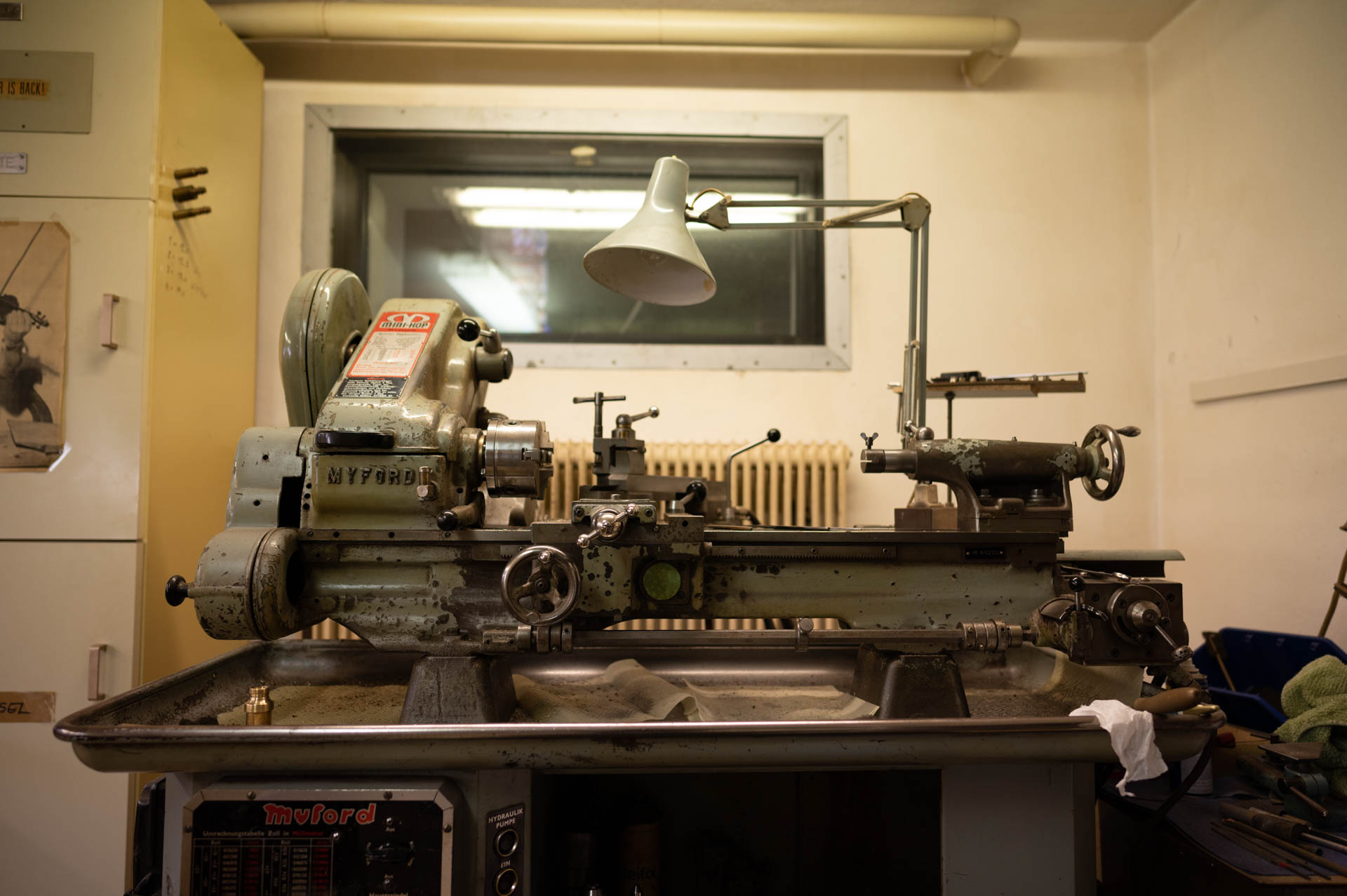
The production of mouthpieces was started by my father Karl Breslmair in 1968 through a story-worthy coincidence. In the collection of the Vienna Philharmonic there was an old trumpet mouthpiece, which was manufactured in a Viennese master workshop. The first trumpet players of the Vienna Philharmonic at the time, Professors Josef Levora and Helmut Wobisch, shared this excellently playable, tonally ideal mouthpiece.
Prof. Wobisch was friends with Wolfgang Higatsberger, professor at the TU Vienna and head of the Seibersdorf Atomic Research Center, to whom he spoke one day about this mouthpiece. Wherever the Vienna Philharmonic were on concert tours, they tried to find instrument makers who could replicate this unique mouthpiece. But no one managed to copy this old unique piece. Higatsberger said he could help him, as almost anything was possible in Seibersdorf.
Perhaps he was already thinking of my father at that moment, who was valued by all researchers as a brilliant technician. He always found solutions in technically hopeless-seeming situations; he knew how to help physicists, chemists, and biologists in an unbureaucratic way. In personal conversation, he recognized problems immediately and usually had patent solutions ready. As a co-founder of the works orchestra, violinist and violin maker (a hobby since early youth), he was the man for Higatsberger who would also know what to do with mouthpieces. Until then, brass music was frowned upon in the Breslmair house. Violin music was our passion. However, the name Vienna Philharmonic made my father prick up his ears. That was a special, honorable task that enticed him. He was to build mouthpieces for arguably the best musicians of that time.
No one could copy this inconspicuous thing or produce an equivalent. Now it was up to my father, who was completely absorbed by this assignment. As a 14-year-old, I was also peripherally involved as a summer intern in the work of my father and his team. I had to interpolate endlessly long columns of numbers and draw coordinate points on graph paper. Months later, the first mouthpieces could be manufactured. My father brought these prototypes to the “stage door” of the Vienna State Opera and handed them over as instructed. All of them bore the designation G1, as the first usable prototype series after the gold-plated (G), old, nameless original.
Within a few weeks, the mouthpieces were distributed among a few top musicians. My father had actually succeeded in developing a mouthpiece that could meet the highest demands. The knowledge of the shapes of the cups and dimensions of the bores could also be transferred to other brass instruments. Breslmair's “Seibersdorfer” mouthpieces were from then on trend-setting and are still an integral part of the Viennese classical music scene today.
 No products in the cart.